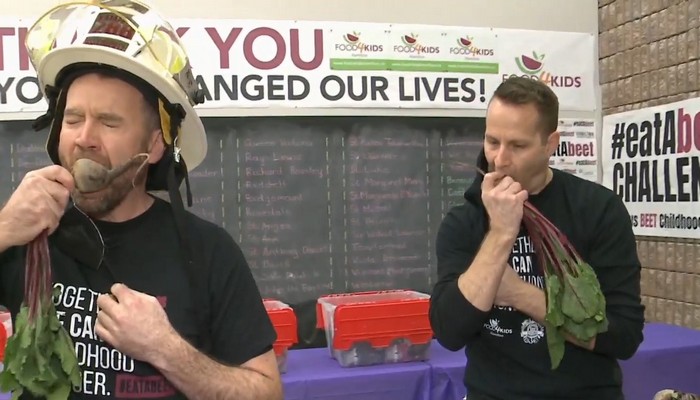
This is the second year for the #eatabeet challenge for Food4Kids, and it’s easy to participate. The rules are as follows:
1.Post a photo or video of you eating a beet.
2. Donate $25 to Food4Kids, or whatever you can donate.
3. Challenge others to participate and donate.
Food4Kids provides food to kids who don’t have access to it. They provide nutritious food to kids in schools in a private way so the kids can receive the food without kids knowing.
During the pandemic they had to pivot, as did the way funds were raised to help them. Instead of a hockey game put on by the Hamilton Firefighters for Charity, the #eatabeet challenge was thought up, and was so successful, why not do it again?!
The Eat a Beet challenge is on now until February 21st.
The Queen enjoys a varied and expensive diet, but there are some things that she refuses to eat because of weird royal protocols.
The Queen has never revealed her favorite meal, so it can be a bit of a mystery piecing together which cuisines Her Majesty enjoys and which foods the Queen would rather stay away from.
Royal chef Darren McGrady, who worked at Buckingham Palace for more than 15 years confirmed that Her Majesty doesn't enjoy eating garlic or onions.
The chef revealed to Recipes Plus that he "can never serve anything with garlic or too many onions."
However, Duchess Camilla suggested that rather than not enjoying garlic and onions, the royals are discouraged from eating this type of food because it may cause them to have bad breath.
When the Duchess appeared on MasterChef Australia she was asked what the royals won't eat, Camilla said, "I hate to say this, but garlic. Garlic is a no-no."
Masterchef judge Gary Mehigan asked if it was discouraged "because you're talking, and chatting all the time," to which she responded, "Yes, exactly. So you always have to lay off the garlic."
Shellfish
(Image credit: Alexander Spatari / Getty Images)
The royals tend to shy away from eating shellfish. This is because shellfish is commonly associated with food poisoning and can easily be cooked incorrectly.
This of course would not be good for royals who often have busy schedules and need to be ready for work or royal engagements at any moment.
Pasta
(Image credit: Iza Łysoń / Getty)
Reportedly Her Majesty doesn't eat too much pasta or rice or potatoes as she prefers to stay away from starchy foods.
Apparently, the royals will only have pasta, potatoes, and rice on rare occasions and the Queen prefers to have lighter meals that are less filling than typical dishes that include these items.
Foods the Queen does like
Strawberries
(Image credit: Deborah Pendell / Getty Images)
The Queen reportedly loves strawberries, but she refuses to eat them if they are not in season and locally sourced.
Darren McGrady revealed that when she is in Balmoral for the Summer, she adores eating this tasty fruit.“You can send strawberries every day to the Queen during summer at Balmoral and she'll never say a word. Try including strawberries on the menu in January and she'll scrub out the line and say don't dare send me genetically modified strawberries,” said Darren.
Darren McGrady told Insider that as well as dressing her burger with an interesting sauce, the Queen also eats her burgers with a knife and fork. "Her Majesty's Victorian upbringing dictates that the only thing you would pick up and eat with your fingers is afternoon tea," said the chef.
Tuna sandwiches
(Image credit: bhofack2 / Getty Images)
Reportedly, Her Majesty loves sandwiches and has a particular penchant for tuna mayo sandwiches. The Queen likes to have thin slices of cucumber and a light dash of black pepper in her tuna sandwiches.
The Queen also likes to have buttered bread, but without any crusts. A former royal chef, Owen Hodgson, told The Telegraph, “A chef told me off for serving the sandwiches with crusts."
With Ontario restaurant dining rooms closed until Jan. 31, Cobourg is using social media with the hopes of encouraging residents to “Eat Local.”
The Town of Cobourg’s economic development department, in collaboration with the Cobourg Downtown Business Improvement Area (DBIA), recently launched the “Eat Local” campaign in support of local cafés, bakeries, pubs and restaurants that are offering take-out services under the current government regulations that prohibit indoor diners.
The social media campaign was created to help local eateries advertise their take-out menus and food services being provided to the community.
“The Cobourg DBIA would like to remind everyone that all of our business and services are open in accordance with current government regulations,” said Deborah Annibalini, DBIA administrator.
“Please be kind to one another during this time and remember to support your local downtown businesses.”
The “Eat Local” take-out campaign includes two new eateries featured on the DBIA and Town of Cobourg’s respective social media pages weekly.
The DBIA will showcase downtown businesses every Tuesday with the town covering eateries across Cobourg on Thursdays.
Features will include information about take-out menus, hours of operation and product photos.
"This campaign will really put a spotlight on the wonderful local food establishments we have here in Cobourg,” said Ashley Purdy, communications manager for the Town of Cobourg.
“I am pleased to collaborate with the Cobourg DBIA on a campaign that will help further support our local economy through this pandemic.”
This campaign is one of a few recent initiatives the town’s economic development department has launched during the COVID-19 pandemic to assist small businesses.
Be sure to “like” or “follow” these social media accounts to see the campaign posts:
The campaign is open to any business within the town of Cobourg. If your business currently offers take-out services and you would like to be featured in the campaign, e-mail econdev@cobourg.ca.
From wizened street vendors who perform alchemy with sizzling woks to whiz-kid chefs who are shaping the fine dining scene, the city lays claim to one of the world's most multifaceted food scenes.
That's why eating is a thread that runs through even a short stay in the Thai capital.
Chinatown and Rattanakosin
Bangkok's oldest enclaves encompass visitor highlights such as the Grand Palace and the riverside temple of Wat Pho. Other draws include neighborhoods such as Chinatown and Banglamphu, both which abound with eating options.
For an old-school start to the day, visitors can fuel up with sweetened coffee, soft-boiled eggs and pillowy toast spread thick with butter and sangkaya (coconut custard made from a tropical plant called pandan) at On Luk Yun.
After perusing the royal sights, travelers can stop for lunch at Roti Mataba for pan-fried flatbread stuffed with spicy fillings.
Roti Mataba serves buttery, fried roti flatbread, which comes stuffed, served with curry or slathered with sweetened condensed milk and sugar.
Palani Mohan | Getty Images
For a more upscale midday meal, there's Nusara, where Michelin-starred chef Thitid "Ton" Tassanakajohn pays tribute to his late grandmother with his spin on traditional Thai recipes. He said it can be challenging to please both travelers and discerning local guests, who often want different things.
"Tourists want to taste what Thai food is all about — they want to try the traditional recipes," he said. "On the other hand, local Thai guests like to eat something that tastes familiar, but ... they want something new, so it's forcing chefs to find new ways of working with Thai ingredients and flavors."
Snacking is a huge part of Thai eating culture. For this, there's Nai Mong, which serves hoi thod (oyster pancake), near the Wat Mangkon train station, or Lao Tang for tender, braised goose meat in the heart of Yaowarat Road, Chinatown's main drag.
Lines form early in the evening outside Jay Fai where the Michelin-starred owner packs in visiting foodies with dishes such as pad kee mao (drunken noodles) and khai jiew poo (crab omelet).
Jay Fai is Thailand's first street food venue to win a Michelin star. The chef and owner, Supinya Junsuta, who is in her 70s, covers her eyes with ski goggles to make her wok-fried dishes in Bangkok, Thailand.
Anusak Laowilas | NurPhoto | Getty Images
A more refined Michelin-garlanded alternative in the old city is 80/20, where Canadian chef Andrew Martin enhances the restaurant's reputation for boundary-burning flair.
Highlights of his menu include the "Stormy Sea," a dish of squid, mangosteen and chili, inspired by the chef's fishing trips to southern Thailand, and "Isaan Market," which focuses solely on seasonal mushrooms found in the mountainous areas of the country's northeast region.
Silom and Sathorn
There's nothing remotely buttoned up about the eating scene in the business districts of Silom and Sathorn.
Jok Prince, near the junction of Silom Road and Charoenkrung Road, is a stall famous for its smooth, smoky jok (Thai-style rice congee). From there, it's a short walk to Tuang by Chef Yip, which serves some of the city's best — and cheapest — dim sum.
Visitors can weave eastward between Sathorn Road and Silom Road, stopping at the century-old Hindu shrine Sri Mariamman Temple and some of the area's best-known street vendors, along the way.
Two of these have their specialties right in their names. Som Tam Jay So, on Soi Phiphat 2 between Convent Road and Chong Nonsi Skytrain station, serves must-try "som tam," or spicy papaya salad. Close to the Shangri-La Bangkok, Baan Phadthai, which means "House of Pad Thai," is well known for what is perhaps the country's most famous dish of all.
Som tam is a sweet Thai salad made with upripe papaya, long beans, lime, garlic, peanuts and sugar.
dontree_m | iStock | Getty Images
For a memorable fine dining dinner, there's Saawaan, where Sujira "Aom" Pongmorn serves up beef salads, crab fat dips, grilled pork neck and spicy-sour soups in delicate tasting portions.
For a break from Thai food, travelers can head to Yen Akat Road — one of the area's most happening thoroughfares — for beef tartare and truffle risotto at Cagette Canteen & Deli. For a different side of Europe, there's the double-Michelin-starred Suhring, a German fine dining restaurant run by twin brothers that was voted No. 6 on "Asia's 50 Best Restaurants" in 2021.
Siam and Sukhumvit
The hyper-commercial heart of Bangkok is more than just a shopper's paradise. Breakfast here can be a healthy acai bowl or breakfast burrito from Luka at Siri House, a plush haven with beautiful, leafy grounds near the Chidlom Skytrain station.
For a more formal Thai lunch, there's Paste — voted No. 38 on "Asia's 50 Best Restaurants" list in 2020 — where traditional cuisine is served with creative twists.
Travelers can follow the office crowds to Sanguan Sri on Witthayu Road to sample fragrant curries such as gaeng kiew wan nuea (beef green curry) in this expatriate-friendly part of Bangkok.
A spirit of culinary internationalism is alive and well at venues like Appia, a Roman-style trattoria, as well as El Mercado, where a hand-chalked menu features mains such as New Zealand mussels and Australian tenderloin.
Mango sticky rice is a simple but famous Thai dessert made with glutinous rice, coconut milk, ripe mangos and mung beans.
The Washington Post | Getty Images
Those who want to celebrate a trip to Bangkok in style can do so in the lively surroundings at Mia. It's exquisite tasting menu highlights confit cod with gambas mousseline and mussels and Hokkaido scallop with apple and dill sorbet.
If there's still space, a final touch of Thai food can be had at Mae Varee, at the junction of Sukhumvit Road and Sukhumvit 55. It's a fruit shop that is famous for serving the classic Thai dessert, mango sticky rice. It's currently ranked No. 10 out of 428 dessert venues in Bangkok.


/https://www.thepeterboroughexaminer.com/content/dam/localcommunities/northumberland_news/news/2022/01/26/town-of-cobourg-dbia-invites-residents-to-eat-local/10559722_cobourg.jpg)