With its signature matte covers, palette of washed-out earth tones and emphasis on all things artisanal, Kinfolk magazine has had an outsized influence on culture over the past decade, from the look of Instagram to the popularity of slow fashion. Now, as the world reopens and travellers prepare to hit the road en masse, the Copenhagen-based publisher is aiming to put its stamp on the travel guide genre with a new book, “Kinfolk Travel: Slower Ways to See the World” (out Nov. 16).
“Travel has sort of always been in the wheelhouse of Kinfolk, but publishing quarterly, and not having a digital editorial presence, it’s always felt a bit limited in terms of what we can do,” says John Burns, Kinfolk’s editor-in-chief. “We had often talked about producing a series of city guides, but they go out of date so quickly, and we are about longevity and intentionality, so we wanted to produce something that was a bit more evergreen and inspiring.”
Instead of listing hotels, restaurants, shops and landmarks for each destination, “Kinfolk Travel” takes a more eclectic approach, offering guided tours of unconventional destinations (think Albania, Idaho and the Faroe Islands) from stylish locals. From the best places to buy books in Baltimore to the fashion boutiques of Dakar to the bars of downtown Santiago, each chapter offers an introduction to a place through an unexpected cultural lens.
“It’s about getting to know the place on your own terms rather than following some sort of spoon-fed itinerary,” says Burns. “We want you to just pursue your own interests and see things at your own pace. Just explore, basically.”
Burns’ adopted hometown of Copenhagen is notably absent from “Kinfolk Travel,” so he shared with us an introduction to the best places to eat, drink and explore in and around the Danish capital.
Built in a historic wooden house a short drive from Copenhagen (and easily accessible by public transit), this seaside boutique hotel makes for a charming getaway from the big-city bustle. Rooms are outfitted in Scandi style by Danish design studio EEN, and in the spirit of Danish hygge, the evening meal is served communally, complete with cosy blankets and a roaring fire. “You end up talking to the other guests, which I feel is a rare thing,” says Burns. “Beyond that, it’s just beautifully decorated, and the town has this windswept beach that’s really spectacular.”
For eclectic plant-based cuisine:Baka d’Busk (Rantzausgade 44, Copenhagen)
This newcomer to Copenhagen’s vibrant restaurant scene takes a different approach to modern Nordic cuisine with its ever-changing menu of plant-based dishes and a colourfully decorated dining room. “There are a lot of good restaurants in Copenhagen, but Baka d’Busk feels like an antithesis to many of them,” says Burns. “It’s very inventive and the food is beautifully presented, but the atmosphere is really unfussy. It feels like something new in the city.”
For people-watching and unusual wines:Pompette (Møllegade 3, Copenhagen)
“It’s a bit of a scene, but it’s unpretentious,” says Burns of this natural wine bar and bottle shop in Nørrebro, one of Copenhagen’s hippest quarters. Come for well-priced glasses of wine and snacks, and stay to take style notes from fashionable Danes congregated around the bar.
For top-shelf pastries:Lille Bakery (Refshalevej 213B, Copenhagen)
“There are bakeries on every corner in Copenhagen, but this is one of the best,” says Burns of this coffee shop, bakery and bistro in the former industrial neighbourhood of Refshaleøen. Grab a coffee and a kanelsnegle (Denmark’s take on the cinnamon roll) and then hunt for the credenza of your dreams at the nearby Danish Antique & Modern furniture warehouse.
For colourful Scandinavian fashion:Henrik Vibskov (Gammel Mønt 14, Copenhagen)
Alongside Lego bricks and Carlsberg beer, one of Denmark’s most famous exports is Henrik Vibskov’s colourful and oddly proportioned creations, which can be found at his quirky Central Copenhagen boutique. “I like him because I think when you think of Scandinavian style, it’s very clean, minimal, and conservative, and I think he’s just a fantastic antidote to all of that,” says Burns.
“I know it’s a classic, but everybody here loves it, and it’s just such a beautiful place,” says Burns of Denmark’s most famous art gallery, located in a former private home north of the city. Burns likes to stroll the sculpture gardens in summer, but regardless of the weather, he always makes time to visit the North Wing’s Giacometti Gallery, home to one of the foremost collections of sculptures from the mid-century Swiss expressionist.
Travellers are reminded to check on public health restrictions that could affect their plans.
In Australia, one in every five employees are shift workers. But when you work irregular hours, you eat at irregular hours and this can put you at increased risk of weight gain, type 2 diabetes, and cardiovascular disease.
One in five Australian employees are shift workers. Image Credit: University of South Australia
Now, a world-first study conducted by the University of South Australia and Monash University is investigating strategies to help shift workers better manage their eating habits when they work at night.
The SWIFt study – funded by the National Health and Medical Research Council (NHMRC) – is focused on finding suitable diet plans that can empower shift workers to better regulate their health.
In Australia, 1.5 million Australians are employed as shift workers, with more than 200,000 regularly working a night or evening shift.
UniSA researcher Dr Michelle Headland says that the combination of irregular sleep patterns and eating round the clock can seriously affect shift workers’ health.
“When you work irregular hours, your eating and sleeping patterns are affected, causing metabolic changes that can affect your health,” Dr Headland says.
Our body relies upon regular rhythms of energy storage and usage, guided by day and night. When we upset this balance by eating or sleeping at odd hours, our body can’t compensate, and we end up with higher levels of glucose which contributes to weight gain. Shift work makes traditional weight loss plans extremely hard to follow, so what we’ve been doing is exploring alternatives.”
Dr Michelle Headland, UniSA Researcher
Related Stories
Co-researcher and UniSA colleague Professor Alison Coates says that the best way to stay healthy as a shift worker is through education.
“Prevention often comes hand in hand with education. If we can ensure that Australia’s shift workers are informed about healthy food options for the night shift, they can learn to make simple and sustainable changes to their diets,” Prof Coates says.
“Being prepared is key. By spending as little as 10 minutes a day on planning and preparing your meals, you’re more likely to snack on healthier foods and avoid treats from the vending machine.
“Of course, a healthy variety of foods increases your chance of optimal nutrition, and if you include high-fiber and low-GI foods, you’ll not only stay fuller for longer, but also regulate your glucose and cholesterol levels.
“Choosing smaller serves or meals when you’re on a night shift can stop you from feeling drowsy, without taking on too many calories, and drink water to stay hydrated, as opposed to a coffee – it may perk you up, but too much can drag your health down.”
The SWIFt study has over 200 enrolled participants and is currently on a final round of recruitment.
To mark the beginning of The Irish Times’ Food Month 2021 we asked some readers around the world to tell us about the food they eat, how they shop and the food culture where they live. Here, they show us 10 things that are always in their shopping basket
VIETNAM
Sarah Clayton-Lea (28) from Ashbourne, CoMeath, has been based between Vietnam and Thailand for the last three years. She is the founder of Big 7 Traveland currently lives in Ho Chi Minh City with her two foster dogs.
Sarah Clayton-Lea's shopping in Ho Chi Minh, Vietnam
1. Cam sành (Vietnamese green oranges) (1kg, €1.14/30,000 VND) The lady at my local launderette recently started selling Cam sành from her provincial hometown, so I buy a few whenever I stop by. 2. Red dragon fruit (€0.95/25,000 VND for 1kg) The variety of fruit is one of my favourite things about living here, and dragon fruit is always in my fridge. 3. Fresh coriander (€0.38/10,000 VND for 50g) 4. Fresh chillies (€0.30/8,000 VND for 50g) Fresh herbs and chillies are an essential part of Vietnamese cuisine, so I throw them in most dishes for extra flavour. 5. King prawns (€3.03/80,000 VND for 500g) I cook a lot of fish (my housemate is pescatarian), so I don’t usually buy meat to cook at home, unless as a treat for our dogs. 6. Salmon (€8.25/218,000 VND for 865g) I like local king prawns but buy imported Norwegian salmon as I find it’s better quality. It’s more than double the price of local Vietnamese salmon but it’s worth it. 7. Eggs (€1.06/28,000 VND for six) 8. Avonmore salted butter (€4.13/ 109,000 VND for 200g) I can’t live without butter and am convinced Ireland has the best dairy products in the world. 9. Reed avocado (€1.14/30,000 VND for 1kg) I like the Reed avocado, which is larger and rounder than the typical Hass avocado found in Ireland, and has a much creamier and smoother texture. 10. Pizza 4Ps scamorza cheese (€2.65/ 70,000 VND for 115g) This speciality cheese is made by a local brand. I like to eat it sprinkled on top of scrambled eggs.
Sarah Clayton-Lea
The main difference between grocery shopping in Ireland and Vietnam is there is no such thing as a “big shop” here. I buy items as and when I need them, going several times a week to various stores and street stalls.
You never know what you’ll find when you’re out and about so I often end up getting some pretty random fruits or vegetables. On my street alone, neighbours sell fresh seafood, star fruit (from their own tree), eggs and avocados, which they buy early in the morning from a wholesale market and then resell. People here tend to go food shopping daily, pulling up beside the stalls on their motorbikes to buy what they need for each meal.
I love Ton That Dam Market, the oldest wet market in Ho Chi Minh’s city centre, for fish, fruits and vegetables. Anan Restaurant, named among Asia’s 50 best restaurants, is right in the middle of it and it’s where chef Peter Cuong Franklin sources his ingredients. The market is on prime real estate and is a stark contrast to the modern Bitexco Tower that looms over it, but this traditional trading won’t last forever, as the city administration has plans to demolish it.
For more items such as cheese, butter and imported fish, I shop at Annam Gourmet, a French-Vietnamese delicatessen chain. In general, cheese and butter are more expensive here than in Ireland, as they’re not so commonly used in Vietnamese cooking. The flavour of fruit like mangoes, guava, mangosteens and dragon fruit doesn’t compare to any I’ve tried back in Ireland. Vietnam produces several varieties of avocado too. Avocados are cheap here, about €1 per kg, so as a millennial I guess I’ve no excuse for not being able to afford a house.
I used to either eat out or order delivery for almost every meal, but since restaurants are closed for dine-in here with lockdown, I’ve been cooking almost every day. Street food is so cheap and fast here that it never made much sense to cook at home before but I’ve been enjoying cooking more with Vietnamese ingredients. Local restaurants here also add sugar (and sometimes MSG, or bot ngot in Vietnamese which translates to “sweet powder”) to everything, so it’s healthier to cook at home. The only food items I miss are Irish pork products such as rashers, sausages and black pudding, so I’ll be eating my body weight in those when I visit Ireland in December.
AUSTRALIA
Aoife Richardson (40) from Tramore has been living in Australia for 12 years, where she is operations manager for a company specialising in training for mental health professionals. She lives in Byron Bay with her daughters Grace (9) and Georgia (7).
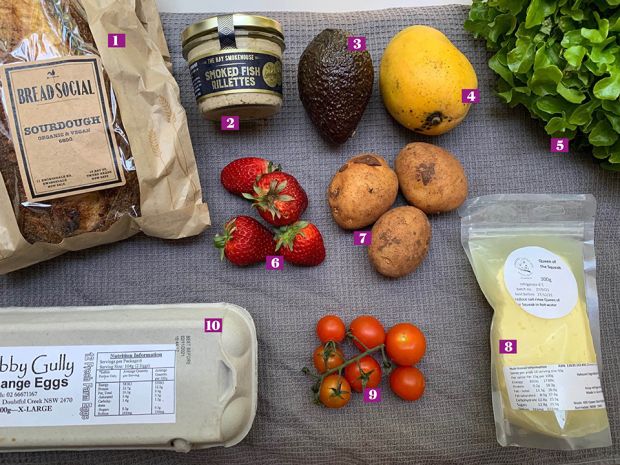
Aoife Richardson's food shop in Byron Bay, Australia
1. Bread Social Sourdough (€5.18/8 AUD)from a local bakery. It’s the best sourdough in town and we love it. Sourdough is really popular here, so it’s easy to find. I’d love to make my own, and have tried, but I don’t have the patience or the time for it. 2. The Bay Smokehouse Smoked Fish Rillettes (€9.70/14.99 AUD) Admittedly this is not a weekly buy, it’s a treat from the farmers’ market or a special grocery store. It’s delicious on fresh bread or crackers. 3. Avocado (€3.24/5 AUD for eight) It’s avocado season so they’re really cheap. We bought a bag from a street stall with an honesty box on our way home from school. 4. Mango (€1.29/1.99 AUD) I bought this at the supermarket, but soon they’ll be in season. Our friends have mango trees at their place and each year a group of us will pick as many as we can. What we don’t eat, we’ll freeze for later in the year. 5. Lettuce (€1.20/2 AUD) from the local farmers’ market. There’s a market in this area seven days a week. Nothing beats fresh fruit and veggies grown locally. I’ve just planted lettuce, rocket and spinach in our garden. We’ll have greens with every meal then through summer. 6. Strawberries (€1.62/2.50 AUD) from the supermarket. These have gone up in price as the seasons change. A few weeks ago you could get a punnet for $1 (€0.65). I have such fond memories of Irish summers when strawberries and new potatoes were sold at stalls on the side of the road. 7. Potatoes (€3.24/5 AUD per kg) These are consistently cheap and always taste better from the farmers’ market, but never as good as back home. As an Irish woman I love potatoes and am often teased for it here. My potato salad has become legendary at our friends’ barbecues. I can’t take any credit though, my father is a wonderful cook and the recipe I have is handwritten by me observing him make it. I use potatoes a lot. In winter I make potato and leek soup often, again from my father’s recipe. I’ll often message him to ask advice about an ingredient or a dish I’m planning. 8. Cheeses Loves You Queen of the Squeek (€7.77/12 AUD) A local woman runs a dairy here and makes the most amazing cheeses, cultured butter and milk kefir. This one is halloumi, lip-smackingly salty and absolutely gorgeous. The kids love it, and we’ll fry it and serve with a big salad. 9. Tomatoes (€2.26/3.50 AUD) from the farmers’ market. A staple in the kids’ lunch boxes along with strawberries, blueberries and carrot sticks. 10. Scrubby Gully Free Range Eggs (€5.17/7.99 AUD) I buy free-range and organic eggs whenever possible. There are lots of roadside stalls that sell eggs, but some weeks I’ll buy at the local Spar. We eat eggs a lot; one of my favourite sandwiches is egg, mayo and lettuce. We had our own chickens, but we’ve since moved. One day I hope to have a bigger property here where I’ll grow as much of our own veggies and fruit as I can and have a menagerie of animals to look after.
Aoife Richardson
We eat a lot of fruit and vegetables, I’ve made sure the kids eat most things and at least try everything they’re given, though they hate pumpkin and love Brussels sprouts. We live in an area that is abundant with fresh produce. It’s easy to grow most things in this climate, hot but often wet through summer too. Byron Bay is a town that is extremely popular, even more so since the pandemic. There are so many cafes in town and coffee is hugely popular, with a selection of milks – cow, soy, almond, oat, macadamia, hemp and I even saw camel milk offered once!
We often pop into the local bakery for a coffee and croissant on the weekends but don’t often eat out. On the rare occasion I get out with friends we’ll try a new place, there’s always somewhere new opening here. I grew up watching my father grow his own veggies and cooking strange and unusual things. He was vegetarian and we ate lots of curries, dahls, stir-frys with amazing flavours, never bland. I’ve definitely taken that on board and have a great love for cooking. I’m often found in the kitchen, particularly on a Sunday afternoon, with a few pots bubbling and the oven going.
SOUTH AFRICA
Gavin Pollock (48), originally from Coleraine, Co Derry, has spent the last 30 years living in England, India and South Africa. He now works in arts education in Durban, South Africa.
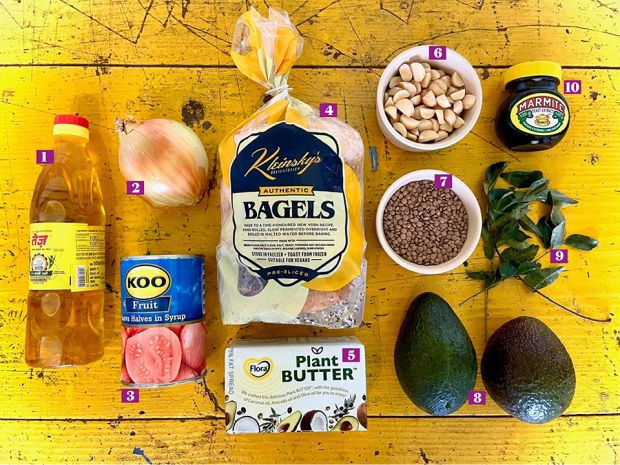
Gavin Pollock's shopping in Durban, South Africa
1. Mustard Oil (€1.45/25 ZAR) Having lived in Kolkata, this is the flavour of West Bengal, the way coconut is used in south India. Strong and pungent, it takes some getting used to but then becomes strangely addictive. 2. Onions (€0.70/12 ZAR per kg) After civil unrest and looting in the city in July, weirdly onions became the most sought-after commodity. I vowed never to run out again. 3. Can of guavas (€1.75/30 ZAR) Trish Deseine’s tropical fruit crumble recipe is a staple for entertaining here – the canned guavas are my secret weapon. 4. Bag of bagels (€2.90/50 ZAR) Because life is too short to boil a bagel – and I did try during lockdown. These are produced in Cape Town and are excellent. 5. Vegan butter (€3.60/62 ZAR) Relatively new on the market here and gives a better result over margarine. 6. Macadamia Nuts (€3/52 ZAR per 500g) Locally grown here in KwaZulu-Natal province, and a less extravagant option than pine nuts. 7. Lentils (€1.15/20 ZAR per 500g) Available from any corner shop in Durban and an essential store cupboard ingredient. 8. Avocados (€2.33/40 ZAR per kg) Some of the best avocados grow locally and when in season are available at rock-bottom prices. Many think Nigella invented avocado on toast but it’s been a staple here for decades. 9. Curry Leaves (Free) Delightful herb, adding freshness to Indian food. It even grows in the garden. 10. Marmite (€3.15/54 ZAR) Essential to a vegan household for adding umami, it’s often associated with scare stories here that stock is running out. I also have an extra jar in the cupboard.
Gavin Pollock
My partner, Duncan, has been vegan since we went into lockdown and since I do most of the cooking, it made sense for me to follow suit. I resisted the changeover to veganism for some time. As a keen baker, I was concerned about having to use complicated, expensive substitutes, but it’s been surprisingly straightforward. My mother’s old Women’s Institute cookbooks are a fount of knowledge on vegan baking without the authors even realising – frugality was important then and not every recipe was filled with eggs, butter and cream.
Tropical Durban has the largest Indian population in South Africa and ingredients from the sub-continent are easy to come by, with regional Indian restaurants widespread and great value for money. We also have numerous sushi bars with vegan options. Eating out is such an affordable option here that we eat out quite a lot.
Food shopping can be as diverse as you want it to be, from traditional African markets to the swankiest of delis. Anything imported is generally very expensive but South Africans have become adept in producing their own versions of international ingredients. South Africa has many climates which means we have a lot of choice each season, and what doesn’t get imported is sold at very reasonable prices. When in season, produce such as local avocados or bananas are at give-away prices – it’s one reason that jam and preserve making is such a tradition here.
With such a diverse mix of nationalities you can pretty much find anything that you need. With lockdown, the drive behind internet shopping took off and it has become very simple to source previously difficult-to-find items.
The one thing I still struggle with living in the southern hemisphere is our Christmas times are hot and it can be a bit incongruous trying to whip up traditional festive treats, but I still carry on. Over the years a bowl of champ has become the most requested item from friends here.
I miss a proper yellow turnip/swede as you can’t get them. Nor those lovely little home bakeries filled with potato bread and soda farls. I have a sweet tooth so I also long for tray bakes and the daffodil yellow, iced pineapple tart. On occasion the call of a wee curried chip is too much . . . making your own is never the same.
GERMANY
Mary Kelly (44) is an actressand playwright who has lived in Berlin since 2011. She is also a Dubs (GAA) fan.
Mary Kelly's groceries in Berlin, Germany
To feed yourself regularly in Berlin, you need to know that all supermarkets close on Sundays, and to bring cash when eating out because most restaurants and cafes don’t take cards. Remembering helps, I’m here 10 years, so you’d think I would.
I live in Kreuzberg with my partner. He does the main grocery shop every week and I pick up a few other things along my way.
1. Leberwurst (liver sausage) (€1.50) Leberwurst (which I eat on bread) looks like white pudding but is more like a softer, salty pate. Real Berliners say my leberwurst habit and my time spent here are what bring me closest to receiving the Berliner title. 2. Ayran (€0.25 per pot) This is a salty, sour yogurt drink that sounds awful but is incredibly refreshing. I buy it in Turkish shops. We go through about five a week. 3. Haribo (€0.89 per bag in Lidl) Haribo is a German company, and I grazed on them long before I got here, but the advantage of inhaling Haribo in its homeland is there’s more of it to choose from. I don’t remember any these pico-balla sweets back in Ireland. 4. Chestnuts (Esskastanien) (€0.80 per 100g) Chestnuts start showing up in supermarkets in October each year and can also be purchased hot at the Christmas markets. I roast them in the oven and they’re just as soft and tasty as the Christmas market ones, which cost about ¤4 for 100g. They make the apartment smell Christmassy too.
Mary Kelly
5. Yfood yoghurt drink (€3.95) During the summer I was rehearsing by day and teaching at night, and then performing at night and teaching by day, and regularly tearing the heads off those around me when my blood sugar plummeted. Yfood received investment from the German version of The Apprentice, and claims their Yop-like drinks are a meal. They’re 500 calories so not a meal by my standards, but also not a Yop. they help mind my manners when I’m too busy to eat a meal. 6. Chilli and lemon feta cheese spread (€1) The Turkish community here is the largest outside Turkey. Some of my German friends who only eat typical German food refer to meals containing garlic as “scharf” (sharp/hot/spicy) so to find something that’s actually hot or spicy, I go to the Turkish market or to one of the many Turkish supermarkets close by. This cheese spread ends up on my bread most weeks. 7. Quark (€0.59 per carton) This is a fresh acid-set cheese. Germans love it and so do I. It tastes like a less-sour natural yogurt and is lovely with muesli and fruit or with soup in winter. It’s apparently good for your gut but I’ve also witnessed Berliners spread it on mosquito bites and sunburn to reduce inflammation. We get two cartons a week. 8, 9. Gluten-free granola and bread (€9.30) I’m gluten intolerant and Berlin didn’t care until this year when Aera, a gluten-free bakery, opened up in two locations. Every week I pick up a freshly baked, gluten-free spelt loaf and a packet of granola. They cost €9.30 in total but I’d pay €90. 10. Susucaru (2019) natural wine (€15 for 750ml) Markthalle Neun, a historic Kreuzberg indoor market, built at the end of the 19th century is home to wine shop and bar, Drunk by Nature. They sell delicious natural wines yet to give me a hangover.
Eating out and eating in is a lot cheaper in Berlin than Dublin, and yet there are days I’d not only ditch its weird dairy products but Berlin itself for a single vinegar-soaked bag of proper chipper chips, ideally from the Roma takeaway in Rathfarnham. Remembering helps.
UNITED STATES
Stephen Cass (47) has lived in the US since 1998. He is a science and technology journalist, co-author of the Hollyweird Science books, and occasional science fiction editor. He lives in Queens with his wife and their cat.
Stephen Cass's food shopping in New York
1. Purina Pro Plan dry cat food (€11.19/$13) We feed our own kitten plus multiple cats from a feline colony behind our block. We know several other neighbours also feed them, so we try to balance their nutrition as best we can. 2. Barilla Protein+ Angel Hair spaghetti (€3.01/$3.50) My wife, Annie, likes pasta a lot, so we always have some on hand. 3. Quest protein bar (€3.01/$3.50) We’re on a diet plan, which means lots of high-protein foods and lean meats, such as a protein bar or turkey slices. 4. Hillshire Farm turkey slices (€3/61/$4.19) The turkey is for us and our adopted kitten, Nugget. 5. Fresh, toasted and buttered bagel (€1.08-¤2.58/$1.25-$3) I have this for breakfast every day, from a local cafe. 6, 7, 8, 9. Freshly microwavable meals (about €8.61/$10 per meal) These are part of a subscription service that delivers healthy meals to your door. 10. Barry’s decaffeinated tea (about €7.75/$9 a box) Fortunately, in recent years Barry’s has become a common sight in city supermarkets, saving me from special online ordering.
Stephen Cass
“What weekly grocery shopping trip?” I thought, as I read the invitation to contribute to this article. Like many New Yorkers, our kitchen is somewhat underused – it’s a running joke here that many apartment ovens are used for valuable extra storage instead of baking. Why cook in a city where you can get every type of cuisine delivered to your door, or rarely have to walk more than five or 10 minutes to find a restaurant, cafe or even just a 24-hour bodega deli counter?
That’s certainly the case at breakfast time, where my day starts with a bagel and coffee, nearly always from the Cypress Cafe around the corner from our apartment. During the darkest days of the pandemic lockdown, when refrigerated trucks had to be parked outside nearby Wyckoff hospital to act as temporary morgues, walking to get my bagel was a rare and welcome taste of normal life – albeit one served via one of the cafe’s windows.
When we do eat at home, meals tend to be quick and easy to cook. Microwaveable meals are, of course, the ultimate in convenience, but we wanted something healthier than regular frozen television dinners. So we joined the Freshly subscription service, which prepares fresh microwavable meals and delivers them to our door once a week. We usually choose lower-calorie meals, as the sedentary life of the pandemic meant putting on extra kilos, which we are taking off with the help of a trainer and a diet programme. This involves lots of protein bars and turkey slices.
The turkey is also a favourite treat of our kitten, Nugget, whom we adopted from the feline colony that lives in the backyards of our block. We became aware of the colony when we started spending a lot more time at home during the pandemic. Soon we noticed the furry shapes strolling along fences and flitting behind the fig trees out back. At first we just put out some water, but now we feed from three to eight cats, twice a day. Even more important than the food, once the cats were used to us, we were able to TNR (trap, neuter and release) most of them, which is the approach recommended for managing cat colonies humanely.
I drink Irish tea, made using an artefact rarely seen in US kitchens – an electric kettle. This is partially for the sentiment, but mostly because many US tea brands seem to be composed primarily of floor sweepings, a problem compounded by most restaurants brewing tea with merely hot, rather than boiling, water. The price is high compared to Ireland, but high food prices are a hallmark of New York life – when we visit other states and get a restaurant or grocery bill, we tend to find ourselves automatically checking for the thing or things that must have been left off to come up with such a low total!
IRELAND
Sarah Williams (41), from Cork, is a PR consultant who lives in Dublin with her husband, Mark, and their two children, Amelie (two) and Cian (five months).
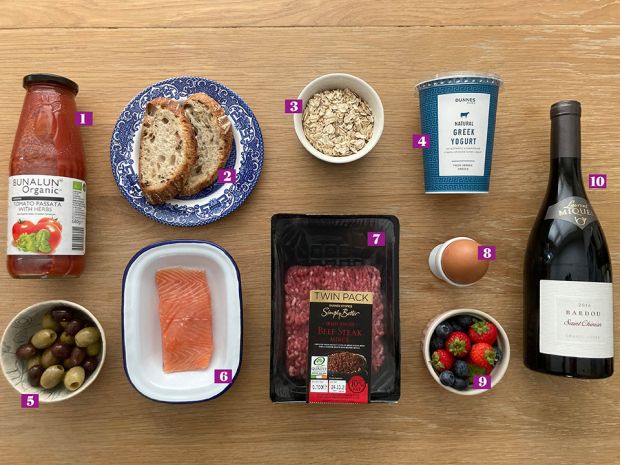
Sarah Williams's shopping basket in Dublin
1. Bunalun organic crushed tomato passata (€2.15 for 680g) We use this about four days a week, for home-made pizza, pasta sauces or one-pot dinners such as chilli con carne, meatballs or bolognese. I love the range from this brand and that this passata has no added sugar and it’s GMO- free. 2. Organic seeded sourdough (€3.50) There’s nothing tastier than this bread, fresh or toasted, with butter or with avocado and eggs at weekends. We started buying sourdough weekly in a local bakery during lockdown and then discovered this one in Dunnes. We now buy it as part of our weekly shop, but get a second loaf from the bakery during the week. 3. Flahavan’s organic porridge oats (€2.79 for 1kg) A morning staple for everyone in this house for a healthy start to the day. But we also use it for making brown bread, porridge bread, Bircher muesli, pancakes and flapjacks. Oats are really good for breastfeeding mums too. 4. Greek yoghurt (€1.69 for 450g) We all love this at any time of the day or night, on its own or with berries and Quinoa Crunch sprinkled on top as a snack. It’s a great source of protein and probiotics. 5. Italian olive mix (€2.99 for 150g) I love snacking on these or having them with wine, especially pre-dinner, at weekends. 6. Skin-on salmon darnes (€9.99 for five, 600g) We are spoiled with fresh fish on this island and I try to eat fish at least twice a week. Myself and my daughter are the only salmon-eaters in the house but we eat enough for the whole family. I also love smoked salmon on brown bread – this was a staple for the last few months for the Omega 3 while I was breastfeeding. 7. Irish Angus beef steak mince (€4 for 550g) A go-to item in our weekly shop or sometimes from the local butcher. This is essential for a few meals every week for us and great for batch cooking. 8. Golden Irish corn-fed, free-range eggs (€2.59 for six) We really should have chickens with the amount of eggs we consume. Hard-boiled eggs in salads, scrambled eggs or boiled eggs for the toddler, poached eggs or omelettes for the adults and baking with eggs. 9. Clarke’s Farm strawberries (€5 for 600g) We always have a selection of berries in the fridge, and freezer too. We use them on porridge, in smoothies, in pancakes, in cakes or on their own as snacks. 10. Laurent Miquel Bardou Saint Chinian Grande Cuvée (€20 for 750ml) A well-earned treat on a Friday or Saturday night after a week with two young children. Usually enjoyed with a nice steak. I enjoy most of the wines from Laurent Miquel’s vineyard and I like that his wife, Neasa, is Irish too.
Sarah Williams
As a family of four, with a 2½ year old and a five-month old, our eating habits have changed a lot over the last few years. We now tend to do a weekly shop online at Dunnes and then restock things like fresh bread, fruit and fish during the week from the local bakery, fruit and veg shop and fishmongers.
During the various lockdowns last year the weekly food shop became a highlight of each week, and good food and drink at home really became a simple pleasure. We use the barbecue at home 12 months of the year and try to cook from scratch and batch-cook when the time allows. But Baxter and Greene dinners, Drop Chef and meals from family and friends have also come to the rescue in recent months, after our second baby was born.
Pre-children, we used to dine out a lot but now if we get out for dinner once a month as a couple we are delighted. We usually enjoy a takeaway once a week and really enjoyed the excellent “dine at home” options from restaurants during the lockdowns, especially from Locks on the canal, 777 on George’s Street, Ananda in Dundrum and Circa in Terenure. Going for brunch with the children or takeaway coffees and pastries in a local park or coffee shop is our new “going out”.
I believe that eating well and really enjoying food is the cornerstone of a healthy and happy life.
With food prices in Canada up nearly four per cent from last year at this time, Richmond dietitians are coming up with solutions on how to eat well without breaking the bank.
According to a recent report from Statistics Canada, its consumer price index was up 4.4 per cent in September compared to the same time last year, and the annual rate of inflation reached its highest level since 2003.
The agency also stated that prices for meat products increased by 9.5 per cent in almost every sector (pork, beef, chicken) in September.
Given the bite consumers are feeling at the supermarket till, this might be a good time to consider a plant-based diet, or bulk buying with a group when items are on sale, said Amy Yiu, a Richmond nutrition counsellor.
“The concept of group buying and sharing has become trendy among the local Chinese Canadian community with some people scheduling to meet together at Richmond’s supermarkets or stores once a week to purchase groceries on sale and later split the food and costs together.
With group buying items on sale, “you don’t need to worry about buying way too much and then later tossing some of it in the garbage. You also don’t need to stress out trying to squeeze out some space to store huge items,” said Yiu.
The group buying concept took off during the pandemic with more people looking for creative ways to support each other while saving money, explained Yiu.
Some people will purchase boxes of fresh vegetables from local farmers and then ask around on social media to see if anyone is interested in chipping in to help cover the costs and share the food, said Yiu.
“If you are interested but don’t have a car, some of them will drive around the city to drop vegetables off in different neighbourhoods,” she said, noting it also goes a long way in helping foster a sense of community spirit.
With meat prices continuing to rise, Priscilla Lau, another Richmond-based registered dietitian, suggests now might be a good time to consider a plant-based diet.
A plant-based diet isn’t just limited to fruits and vegetables but also includes seeds, beans and whole grains, said Lau, adding that a plant-based diet is budget-friendly, yet rich in nutrition.
Besides, she added, people don’t need to become fully vegan to still reap the benefits of a mainly plant-based diet. Just including more plant-based foods can have a positive effect on a person’s health – both physical and financial.
She added, while it’s a challenge to eat well and save money, “it’s not a mission impossible.”
Lau also shared one of her favourite plant-based diet recipe from her website:
Rainbow Vegetable Medley with Dried Bean curd and Quinoa
Serving: 1
Ingredients:
Green, red, yellow bell peppers (1 each)
2 pieces dried bean curd (soybean milk skin)
¼ cup of quinoa
A pinch of salt and pepper
½ teaspoon sugar
2 teaspoons of oil
Thickening agent:
½ cup water
1 teaspoon cornstarch
1 teaspoon light soya sauce
A pinch of sugar
Cooking Method:
1. Chop the green, red and yellow bell peppers into strips and soak the dried bean curd in water, cutting it into smaller chunks. Boil quinoa in salt water over medium heat for 10 minutes until cooked.
2. Add the green, red, yellow bell peppers and dried bean curd into a heated wok with oil and stir fry until cooked. Pour the quinoa into the wok and mix well with the other ingredients.
3. Pour the thickening solution into the wok and mix well with all ingredients to serve.
Ever wanted to wine and dine with a ghost? Well, that choice might not be up to you if your Halloween dinner plans include one of these haunted restaurants in Canada.
Jokes aside, chances of running into a ghostly figure are slim but for those who work and are regulars, there may be a higher chance of having a spooky encounter.
The stories are endless and some even left staff to quit their jobs right on the spot.
Curious to find out more? Here are five reportedly haunted restaurants you can still dine at across Canada:
Are ghosts real? It depends who you ask, but in Vancouver, the most haunted building is The Old Spaghetti Factory at 53 Water Street in Gastown. Chris Kanuka, senior vice president of Old Spaghetti Factory Canada, has been working at the Gastown Old Spaghetti Factory since 1999. He told Daily Hive that the building was built in 1912 and the restaurant first opened in March 1970. Kanuka said one server was checking the back of the restaurant before they opened to make sure the tables were set. Then, she came up to him, shaking.
“She saw a little boy under one of the booths and went to help him – he was crouched up with his arms around his knees. She bent down at the table when she heard a bang in the back and looked – it was old books off a bookshelf. When she looked back, the boy was gone. She had been with us years, but that was her last shift.”
This may be one of the more obvious, or well-known, haunted buildings in Toronto. It was originally built in 1867 for the McMaster family, and was later purchased by the Massey family. The house is said to be haunted by a young boy who can be seen playing on the stairs where he apparently died. The ghost of a woman has also been reportedly sighted at the Keg Mansion, she is said to be the ghost of a maid in the house who died by suicide after Lillian Massey’s death. It is believed that she haunts the second floor women’s washroom and rumours have it that a cook came into the restaurant early to see the image of a woman hanging from where she had allegedly hung herself in 1915.
If you’re a hungry ghost hunter, Keg Mansion is a good place to grab a bite to eat, and maybe you’ll even get to see one of the ghosts who allegedly call this steakhouse home.
This old firehall turned pub has been featured on the show ‘Creepy Canada’ for the odd occurrences experienced by staff and guests. For example, the dishwasher turning itself on and spraying kitchen workers, oven doors opening and slamming shut on their own, and the opening cook complaining that his shoe laces keep becoming untied on their own.
L’Auberge Saint-Gabriel is the oldest inn in North America. It was built in 1688 by a French soldier and was also the first ‘auberge’ on this continent to receive a liquor licence in 1754. If the lantern-lit walls of the historic inn could talk, they’d tell many tales. The inn is rumoured to be haunted by the ghost of a little girl who died in a fire during the 19th century. Customers at Saint-Gabriel, currently used as a restaurant, reportedly feel ‘cold chills’ inside the narrow, stone-walled venue, even during the dead of summer.
Bed and breakfasts are usually the perfect couple’s retreat. This one, not so much. As the story goes, the couple who originally owned the building were anything but perfect. The owner is said to have murdered his wife in jealously only to drag her body to the basement and burn her remains. He was eventually convicted of murder after bone fragments were found by employees. Unexplained noises, flickering lights, and the appearance of a ghostly woman have been reported ever since. Though the B&B is no more, Gibbard Block has two restaurants, June’s Deli and Fox Burger, along with a boutique liquor store on the main floor.
Continue the conscious celebrations and choose from seed-filled, bejewelled and chocolate firework variants
Edible bombs
@ Dottedi, Bengaluru
Buy your crackers and eat them too! In this Diwali box (₹800), savour two flower pots, one atom bomb, a green bomb, two chakras, two sparklers, and more in dark and milk chocolate. Also available are single ‘bomb’ (₹699) and ‘rocket (₹850) variants in six flavours: dark, crispy, butterscotch, orange and coffee. thedottedi.in
@ Cut The Damn Cake, Assam
Standard and HITT fireworks get an edible makeover courtesy Vedika Kejriwal’s Guwahati-based baking studio. The ‘Patake Ki Dukan’ features coconut oatmeal cookies, chocolate wafer sticks dipped in dark chocolate, peanut bombs infused with dates and roasted nuts, mini cake pops, and more shaped as flower pots, bombs, sparklers, rockets, etc. All in their traditional packaging — bright colours and vintage prints. ₹200 onwards. @cutthedamncake on Instagram. 06002141677
@ Aubree Haute Chocolaterie, Bengaluru
For ‘fiery’ treats, Aubree Haute Chocolaterie’s ‘Choco-Rackers’ collection is back this Diwali with their signature choco-chakra, crispy-pataka, butterscotch flower pot, coffee rockets, elaichiatom bomb, etc. ₹1,299 for the Diwali Chocoracker - Whopper on shop.aubree.in or their outlets in Bengaluru.
Selling out fast this year are the ‘vintage lookalike crackers’ curated by Phool. The brand is known for their ‘flowercycling’ technology that converts floral waste from temples in Uttar Pradesh into charcoal-free incense.
Their Diwali launch features plantable crackers and artisan-made diyas. The Phool Diwali Patakha Box (₹625), for instance, comprises a box of lemongrass-scented incense cones, a box of plantable firecrackers made from waste newspaper and embedded with seeds such as green amaranthus, basil, sponge gourd, etc. Details on phool.co
@ 21 Fools, Jaipur
In 2014, from their workshops in Jaipur and Mumbai, 21Fools introduced ‘Beej Kapas’ — a plantable paper. Ever since, the eco-brand has handcrafted over two million Beej-Kapas, says founder Divyanshu Asopa. When corporate orders for their stationery and blue pottery dried up, he collaborated with farmers, artisans and craftspersons from Kot Jewar, Sanganer, Jodhpur, and Chhindwara to create new products. This year, their Beej Patakha Box comprises lookalike anars,chaklis, rockets andladis that are made using waste cotton paper, live seeds and seed balls (cucumber, mustard, onion, spinach, etc), and hand-painted diyas made by women from Jaipur’s Prajapati community. ₹799 on 21fools.com
Rocket pendants @ Augrav, Coimbatore
Try on a rocket and bullet bomb! The 2021 Diwali collection at Augrav, known for their personalised and 3-D printed jewellery, has quirky gold pendants featuring a whistling rocket (₹15,435 onwards), an atom bomb (₹17,729) a smiling bullet bomb (₹16,626 onwards), and a sparkling flower pot (₹16,891), among others. augrav.com
Singapore’s food agency said biscuits and crackers are safe to consume after a Hong Kong watchdog warned that cancer-causing substances were found in some products, including those manufactured in Malaysia.
Compounds such as acrylamide and glycidol are naturally formed when food products are processed at high temperatures, through frying, baking and roasting. There’s no evidence that “conclusively demonstrates” these substances can cause cancer in humans, the Singapore Food Agency said.
/https://www.thestar.com/content/dam/thestar/life/travel/2021/10/30/where-to-eat-drink-and-explore-in-copenhagen-kinfolk-editor-in-chief-john-burns-shares-his-shortlist/copenhagen_aerial_credit_rolands_varsbergs_unsplash.jpg)











.jpg;w=960;h=427;mode=crop)